


Dreaming of studying in the United Kingdom? Your future starts with the right university, the right course, and the right guidance!
The United Kingdom (UK) continues to be one of the most preferred destinations for international students, particularly those looking for globally recognised qualifications, quality education, and international career exposure. With prestigious universities, industry-focused programmes, and a multicultural learning environment, the UK offers exciting opportunities for students planning to pursue higher education abroad.
Moreover, UK universities offer a wide range of undergraduate and postgraduate programmes, including several one-year master’s degrees. As a result, students can gain valuable international qualifications while completing their postgraduate education in a shorter time frame.
At Sahaj International, we help students explore suitable UK study opportunities through personalised counseling, university selection, admission assistance, documentation, and student visa guidance.
Why Study in the UK? Top Benefits for International Students
Choosing the UK for higher education can open doors to academic development, professional growth, and international exposure. Here are some important reasons why studying in the UK can be a valuable investment in your future.
1. One-Year Master’s Degree in the UK
One of the biggest advantages of studying in the UK is the availability of one-year master’s programmes.
Unlike many other countries where postgraduate degrees generally take two years, several UK universities offer master’s programmes that can be completed in just 12 months.
Consequently, students can:
- Complete their postgraduate education in less time.
- Reduce the overall duration of their studies.
- Gain international academic exposure.
- Prepare for future career opportunities sooner.
Popular options include MSc, MA, MBA, and other specialised postgraduate programmes, depending on university offerings and admission requirements.
2. Post-Study Work Opportunities in the UK
Another major attraction for international students is the UK’s Graduate Route, commonly known as the Post-Study Work (PSW) opportunity.
After successfully completing an eligible course at an approved UK higher education institution, international graduates may apply for a Graduate visa, subject to immigration requirements.
Under the rules applicable as of October 2026:
- Eligible graduates applying on or before 31 December 2026 can receive a Graduate visa for two years.
- Applications made on or after 1 January 2027 will generally receive 18 months.
- Graduates who complete an eligible PhD or other doctoral qualification can receive three years.
Therefore, students should consider their course completion and visa application timelines carefully while planning their UK education journey.
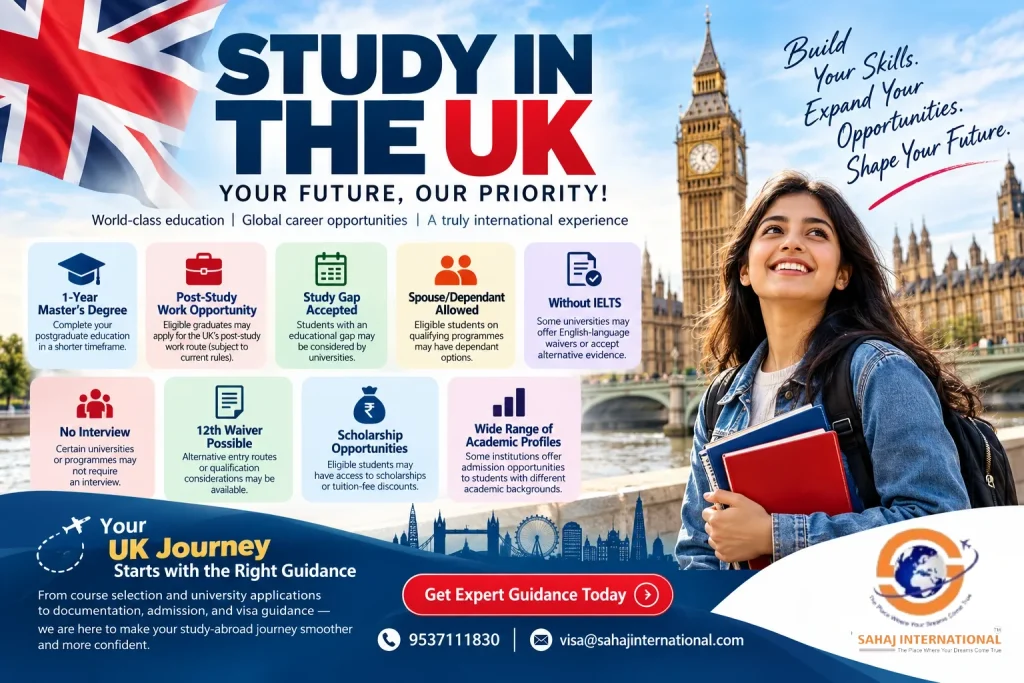
3. Study Gap Accepted by UK Universities
Have you taken a break from your studies? Don’t worry! An educational gap does not automatically mean that you cannot study in the UK.
In fact, many universities may consider students with study gaps, depending on their individual academic profiles and circumstances.
However, universities may assess:
- The duration of the educational gap.
- Reasons for taking a break from education.
- Previous academic performance.
- Employment or professional experience.
- Relevant supporting documents.
- The suitability of the selected course.
Therefore, students should prepare a clear explanation of their study gap and provide supporting evidence wherever required.
4. Spouse and Dependent Visa Options
Students planning to move to the UK with their families should understand the current dependent visa regulations.
Although dependent options are available in certain circumstances, they are not applicable to every international student.
Under current UK Student visa rules, eligible dependents generally include the partners and children of:
- Government-sponsored students undertaking qualifying courses.
- Eligible postgraduate students enrolled in qualifying research-based higher degrees or doctoral programmes.
Importantly, ordinary taught master’s programmes generally do not qualify for dependent applications under the rules introduced in January 2024.
Therefore, students who wish to bring their spouse or children should carefully check their course eligibility before selecting a university.
5. Study in the UK Without IELTS – Is It Possible?
Yes, some students may be able to secure admission to UK universities without submitting an IELTS score.
However, this depends on the university, course, and the applicant’s English-language qualifications.
Some universities may accept:
- Medium of Instruction (MOI) certificates.
- Previous education completed in English.
- Alternative English-language tests.
- University-conducted English assessments.
- Other accepted evidence of English proficiency.
Additionally, students must meet the applicable UK Student visa English-language requirements. For degree-level courses, the required standard is generally CEFR B2, although a qualifying higher education provider may assess the student’s English proficiency itself.
Thus, IELTS is not necessarily the only available route, but English-language requirements cannot simply be ignored.
6. UK Universities With No Mandatory Admission Interview
Are you worried about university interviews?
The good news is that some UK universities and academic programmes do not require a formal admission interview.
Nevertheless, interview requirements vary according to:
- University admission policies.
- Selected courses.
- Academic background.
- Applicant profile.
- Additional verification requirements.
Furthermore, universities may request an interview if they need to assess an applicant’s suitability or clarify certain details.
Therefore, students should check the specific admission process before applying.
7. Alternative Academic Entry Requirements and 12th Qualification Considerations
Students with different academic backgrounds may have alternative admission opportunities at selected UK institutions.
Depending on the university and programme, applicants may be considered through:
- Foundation programmes.
- International Year One programmes.
- Diploma or pathway qualifications.
- Alternative recognised academic qualifications.
- Recognition of prior learning, where permitted.
However, a general 12th qualification waiver is not available across all UK universities. Admission depends on the course’s academic entry requirements and the applicant’s existing qualifications.
8. Scholarships and Tuition Fee Discounts in the UK
Studying abroad can be a significant financial commitment. Fortunately, many UK universities offer scholarships and tuition fee discounts to eligible international students.
These opportunities can help reduce the overall cost of education.
Scholarship opportunities may include:
- Merit-based scholarships.
- Academic excellence awards.
- International student scholarships.
- University-specific tuition fee discounts.
- Country-specific funding opportunities.
However, scholarship amounts, eligibility criteria, and application deadlines vary between universities. Therefore, applying early and selecting the right university can improve your chances of accessing available funding.
9. Opportunities for Students With Different Academic Profiles
Not every student has the same academic journey. Some students have excellent grades, while others may have educational gaps, different qualifications, or professional experience.
Fortunately, certain UK universities offer different academic pathways to accommodate a wider range of student profiles.
Nevertheless, every applicant must meet the university’s specific academic and English-language requirements.
At Sahaj International, we help students explore suitable universities and courses based on their qualifications, academic history, budget, and future goals.
What Are the Requirements to Study in the UK From India?
Before applying to a UK university, Indian students should understand the basic admission and visa requirements.
Generally, applicants may need the following documents:
- Valid passport.
- Academic certificates and transcripts.
- English-language proficiency evidence, where applicable.
- Statement of Purpose (SOP), if required.
- Letters of Recommendation (LOR), if required.
- Updated CV or resume, where applicable.
- Work experience documents, if applicable.
- Confirmation of Acceptance for Studies (CAS).
- Financial documents meeting UK Student visa requirements.
- Tuberculosis (TB) test certificate, where applicable.
Please note that the exact documentation requirements depend on the selected university, course, and individual visa circumstances.
How to Apply for a UK Student Visa From India?
Once you receive an offer from a UK university and meet its admission conditions, the next step is to prepare for your Student visa application.
Here is a simplified overview of the process:
Step 1: Choose Your Course and University
Select a suitable course based on your academic background, career interests, budget, and future plans.
Step 2: Submit Your University Application
Prepare your academic documents and submit your application to the selected university.
Step 3: Receive Your Offer Letter
After evaluating your application, the university may issue a conditional or unconditional offer.
Step 4: Complete the Admission Requirements
Fulfill the university’s academic, English-language, and financial conditions.
Step 5: Receive Your CAS
Once all relevant requirements are completed, the university may issue your Confirmation of Acceptance for Studies.
Step 6: Apply for Your UK Student Visa
Submit your visa application with the required documents and applicable fees.
Step 7: Prepare for Your Journey
After receiving your visa, make the necessary travel and accommodation arrangements before beginning your studies in the UK.
Why Choose Sahaj International for UK Study Abroad Consultancy?
Selecting the right university is an important decision that can shape your academic and professional future. Therefore, having experienced guidance throughout the application process can make a significant difference.
Sahaj International, established in 2008 in Vadodara, Gujarat, provides overseas education consultancy and student support services.
We assist students with:
- Personalised study abroad counseling.
- UK university and course selection.
- Academic profile assessment.
- Admission and application assistance.
- Scholarship opportunity guidance.
- Documentation and SOP guidance.
- Student visa application assistance.
- Pre-departure guidance.
Our objective is to help students make informed decisions and explore suitable international education opportunities.
Frequently Asked Questions (FAQs) About Studying in the UK
1. Can Indian students study in the UK without IELTS?
Yes. Some universities may accept MOI certificates, previous English-medium education, or alternative English assessments. However, students must still satisfy the applicable university and UK Student visa English-language requirements.
2. Can I study a master’s degree in the UK in one year?
Yes. Many UK universities offer master’s programmes that can be completed in 12 months. However, the duration depends on the university and selected course.
3. Is a study gap accepted in the UK?
Yes. Some universities consider applicants with educational gaps. However, admission depends on the duration of the gap, its reason, academic qualifications, supporting documents, and university policies.
4. Can I take my spouse to the UK on a Student visa?
Only certain students can bring dependents. Government-sponsored students on qualifying courses and eligible postgraduate research or doctoral students may qualify. Most students enrolled in ordinary taught master’s programmes cannot bring dependents under the current rules.
5. How long can I stay in the UK after completing my studies?
Eligible graduates applying for the Graduate visa on or before 31 December 2026 can generally stay for two years. Applications from 1 January 2027 will generally receive 18 months, while eligible doctoral graduates can receive three years.
6. Can I get a scholarship to study in the UK?
Yes. Several UK universities offer scholarships and tuition fee discounts to eligible international students. The amount and eligibility criteria depend on the institution and programme.
7. Is an admission interview compulsory for UK universities?
No. Some universities and programmes do not require formal interviews. However, others may conduct interviews as part of their admission or verification process.
8. What is the minimum academic percentage required to study in the UK?
There is no single minimum percentage applicable to all UK universities. Academic requirements vary depending on the course, institution, qualification level, and applicant’s educational background.
Start Your UK Study Abroad Journey With Sahaj International!
A world-class education can be the first step towards achieving your international career goals. Whether you want to pursue a one-year master’s degree, explore scholarship opportunities, or understand your UK admission eligibility, the right guidance can help you move forward with confidence.
Your dream university could be closer than you think!
Get in touch with Sahaj International – Your Trusted Overseas Education Consultant in Vadodara and take the first step towards your UK education journey.
STUDY IN THE UK | BUILD YOUR SKILLS | EXPAND YOUR OPPORTUNITIES | SHAPE YOUR FUTURE
📞 Call Us: 9537111830
📧 Email: visa@sahajinternational.com
SAHAJ INTERNATIONAL
The Place Where Your Dreams Come True! ✨
Important Note: University admission, scholarships, English-language waivers, and visa decisions are subject to individual eligibility and the latest university and UK government regulations. No admission, scholarship, or visa outcome is guaranteed.